Energy-Efficient Robot Feet
Related Ideas
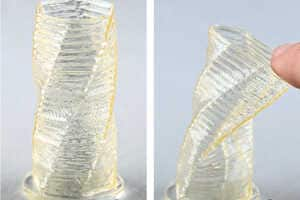



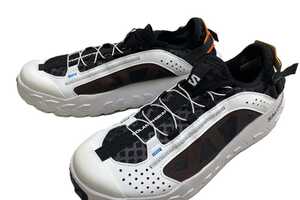


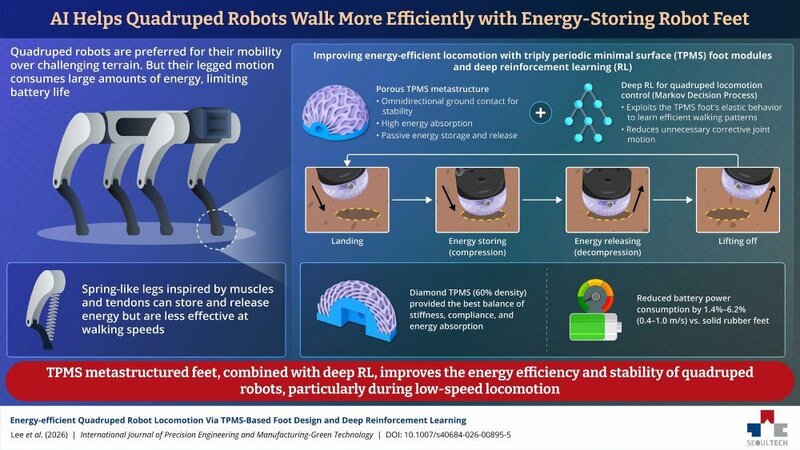
Energy-efficient robot feet are helping reduce the power demands of quadruped robots used in industrial inspection, logistics, and search-and-rescue operations. Researchers at Seoul National University of Science and Technology developed porous 3D-printed triply periodic minimal surface (TPMS) footpads that store and release impact energy during walking. Combined with a deep reinforcement learning controller, the system reduced battery power consumption by up to 6.2% while maintaining stable movement across different walking speeds. By capturing energy that would otherwise be lost, the design enables motors to perform less work without sacrificing mobility.
For robotics manufacturers and industrial operators, improving energy efficiency can extend operating time, reduce charging frequency, and lower maintenance requirements for battery-powered robotic fleets. As autonomous robots become more common in infrastructure monitoring and industrial environments, energy-saving mechanical designs paired with intelligent control systems could improve operational efficiency and reduce overall energy consumption.